

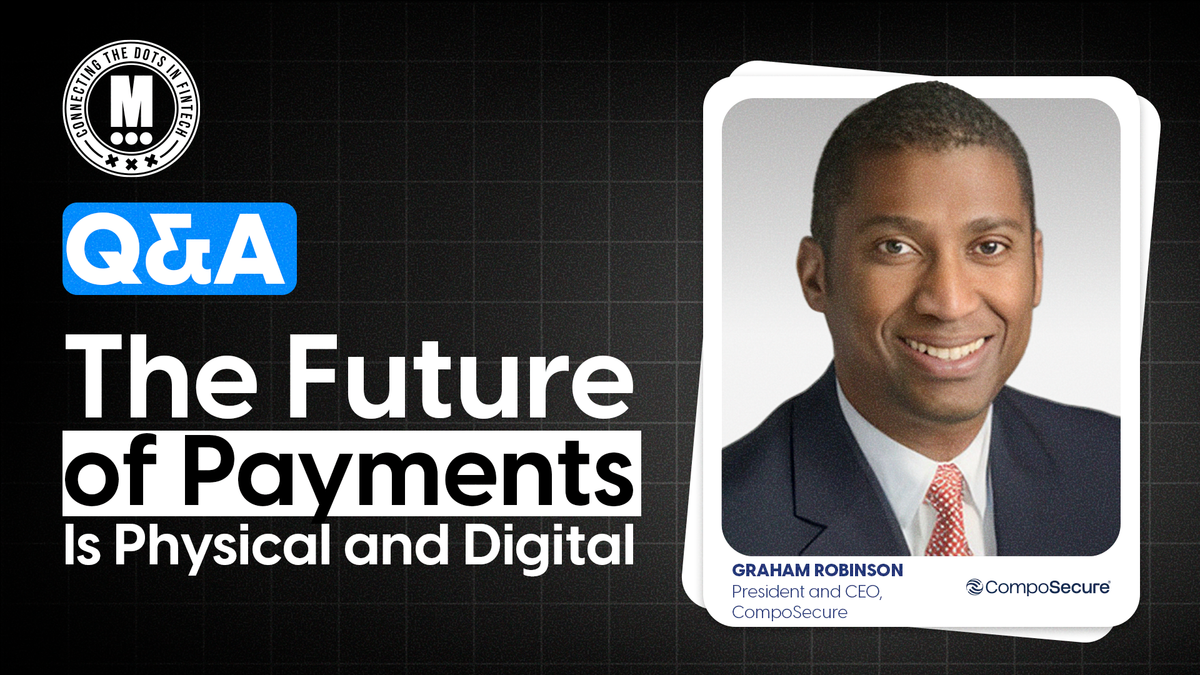
Q&A: The Future of Payments Is Physical and Digital: A Conversation with Graham Robinson President and CEO of Composecure
Hey FinTech Fanatic!
Today, I’m excited to share my latest Q&A with Graham Robinson, President and CEO of Composecure
Before diving in, I recommend:
- Following him on LinkedIn,
- Checking out Composecure
Let’s get to it!
Let's start with a question that I guess is inevitable, but to what extent are people paying with cards today?
Honestly? Cards are still where the action is. In the U.S., debit and credit cards together account for nearly 70% of all point-of-sale transactions, far outpacing mobile wallets at just 15%. Globally, it's the same story: credit cards at 42% and debit cards at 28%, versus 15% for digital wallets. To me, that tells you something important: consumers still want something tangible at the checkout. Something they can hold, feel, and trust.
But here's the thing people often get wrong: this isn't a smartphone versus card story. It's a smartphone and card story. Put them together and you get the best of both worlds. Look at IKEA; they use augmented reality to let customers visualize furniture in their homes. That's a physical experience with a digital twist. Or Chatbooks, who let you turn the photos sitting on your phone into physical photo books - digital experience, tactile finish.
Zoom in on payments and you see the same pattern. Trade Republic is almost entirely digital, but they pair it with a striking metal card with a reflective surface that acts like a mirror. Every time you tap it, you see your own reflection. I mean, how much further can you really take personalization than that? And it's not just them - Coinbase, MetaMask, Gemini, some of the biggest names in Web 3, they're all doing the same thing: digital-first experience, stunning metal card.
And today, Gen Z is all the rage for any consumer-facing organization. Do these digital natives really care about the physical?
This is one of the most interesting things I'm seeing, actually. You'd assume Gen Z would be all-in on digital, and yet they're the ones rediscovering the physical. Look at the resurgence of shopping at physical malls. Or the wave of premium hardback book editions. Or tickets — going from paper to QR codes and now back to premium physical formats that double as commemorative keepsakes. They want stuff they can touch.
And it shows up in banking too. As of Q4 2023, 84% of credit-active Gen Z consumers in the U.S. held at least one credit card, a sharp jump from 61% of Millennials at the same age a decade earlier. And 70% of U.S. Gen Zers visited physical bank branches in 2023. So whether you're a Baby Boomer or a digital-native Gen Zer, there's this clear preference for blending digital and physical.
So what does that mean for financial institutions? Simple: if you want to be in the business of handling Gen Z's money, whether you're a traditional bank or an emerging FinTech, a card gives you an anchor in today's virtual world. Something tangible that says "we're real." And when you make that card out of metal, you're telling the customer something else too: robustness, quality, permanence.
And beyond pure payments, do you see any other uses for the card?
Absolutely, and here is where our Arculus technology comes into play. Remember what we were just saying about blending digital and physical? That same idea could help solve one of the most stubborn problems in payments, the trade-off between fraud and friction in card-not-present (CNP) transactions.
Picture this: you're shopping online on your phone, about to buy a pair of sneakers. Now imagine if all you had to do to authenticate yourself was tap your payment card against your phone. Suddenly, for an online purchase, your physical card is "present." The same logic applies to authenticating a high-value transaction; imagine buying overseas flight tickets for the family holiday. Instead of going through onerous processes with your bank or even worse, having the transaction refused altogether, you just tap your card against your phone to prove that it’s you, and not a fraudster, who is shopping. That's the holy grail right there; you're reducing friction and fraud at the same time, not trading one for the other.
And it tackles first-party/friendly fraud too, you know, where legitimate transactions get contested by the cardholder, mistakenly or otherwise. Zoom in on a segment like gaming and gambling, and you're looking at a $2.8B issue. Try disputing a transaction you literally tapped your own card to verify. Good luck with that.
Looking further out, where else could the card go?
This is where it gets really interesting. There's so much spare capacity in the secure element of a payment card that it can be used for much more than payments, and Arculus opens that door.
One example I love: proving authenticity and provenance for luxury goods. Instead of a paper certificate, imagine a metal card (engraved with the product's serial number and brand logo) coming with the item when it's first sold, elegantly tucked into the packaging. That card links to a digital product passport stored on a blockchain, capturing the item's origin, ownership history, servicing records, and resale events. And to verify any of it? You just tap the card against your phone. Provenance and ownership verification, as intuitive as a tap.
Across the world and in ever more aspects of life, consumers are increasingly prioritizing meaningful and premium experiences, whether it's crafting a bespoke fragrance with a Parisian perfumer or visiting organic producers with a top chef and seeing their dinner ingredients harvested in real time. As a consequence, leading companies across various industries try to make every consumer interaction with the provider memorable. How do you see this shaking out in payments?
This drive is absolutely showing up in payments. A few things stand out to me.
First, 73% of credit card customers say they're motivated by access to exclusive experiences. So if your premium card program isn't reflecting that, you're missing the boat with today's experience-driven consumers.
Second, design has become a real differentiator in how people see their bank. 72% of people care about card design, and nearly half of younger consumers (ages 18–37) rank it as especially important. 64% of Gen Z and 68% of Millennials say the look of the card shapes their perception of the bank. That's huge.
Third — and this is the part I find genuinely fascinating - paying with a plastic card or a smartphone is functional. Efficient, sure, but forgettable. Paying with a metal card is something else entirely. There's a psychological cue ("I have a rare card not everyone has"), an emotional signal ("my bank values me"), and a sensory layer ("I see a beautiful card, feel its weight, hear that distinctive sound when it lands on the counter"). Put all of that together and an everyday action becomes a moment. You're creating a new payment memory every single time the card gets used. That's not something a smartphone tap can match.
Comments ()