

Q&A: Inside Fintech Growth and Attribution: A Conversation with Lesia Kupriienko, Industry Lead at AppsFlyer for the Finance Vertical
Hey FinTech Fanatic!
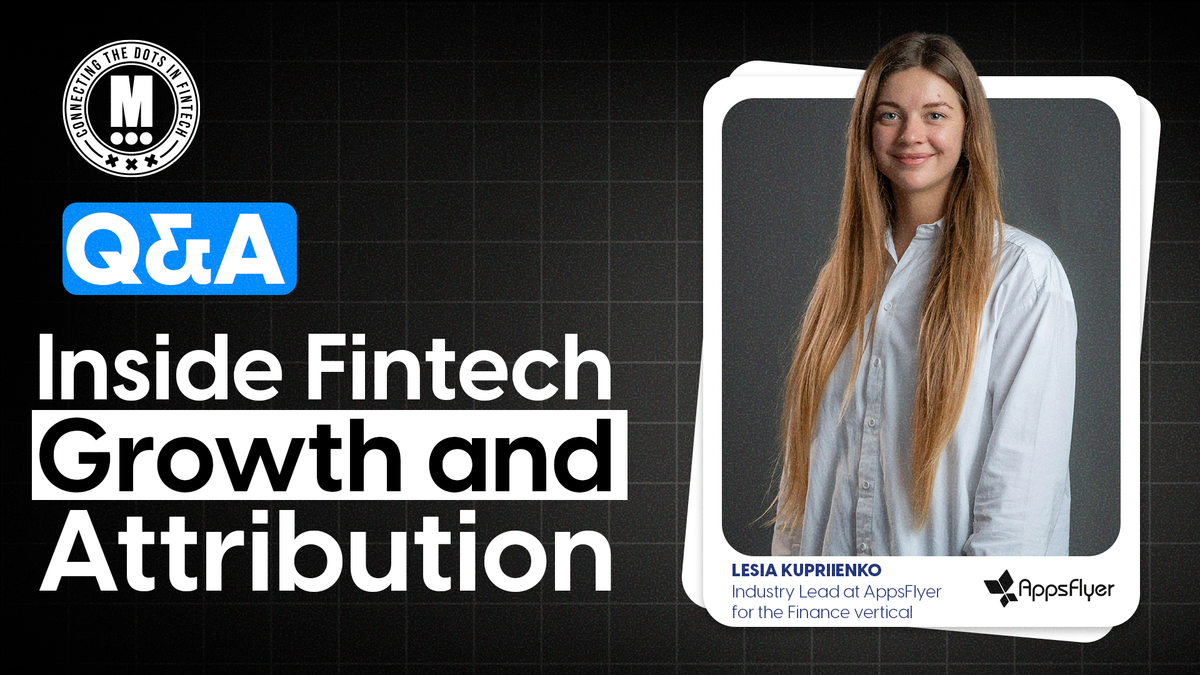
Today, I’m excited to share my latest Q&A with Lesia Kupriienko, Industry Lead at AppsFlyer for the Finance Vertical
Before diving in, I recommend:
Let’s get to it!
Q1: You work specifically on growth and attribution for banking, payments, and financial apps. What's the biggest misconception fintech marketers have about proving ROI in this space?
The biggest mistake I see: marketing and product operating in silos while users move across every channel and touchpoint. The biggest misconception is thinking ROI is one number everyone agrees on. In practice, marketing, product, and data teams are each pulled toward their own KPI — installs, activation, retention, revenue — and whichever one looks good gets called 'ROI.' Without a shared data foundation, you end up with three different growth stories from three different dashboards, and none of them reconcile.
Q2: Mastercard just bought BVNK outright to own stablecoin rails instead of partnering. Does that shift anything for how banking apps think about growth and measurement, or is it still infrastructure that hasn't touched marketing yet?
Right now it's infrastructure, not marketing — but that gap closes fast. Every time a card network or bank absorbs payment rails instead of renting them, it eventually shows up as a growth lever: faster settlement changes what real-time engagement and re-engagement campaigns can promise a user, and owning the rails means owning the data that sits on top of them. The marketing team that isn't already talking to whoever owns that infrastructure decision ends up reacting to a product change instead of shaping the go-to-market around it. Stablecoins specifically matter for anything cross-border — that's where attribution and user experience have historically been worst in fintech.
Q3: Visa acquiring BioCatch for behavioral biometrics landed the same week. Are fraud teams and growth teams inside banks actually starting to talk to each other, or still two separate worlds?
Unfortunately, still two separate worlds. Fraud teams and marketing teams are often not even talking about the same "fraud" — one means payment or transaction fraud, the other means traffic and attribution fraud — and there's rarely a shared view between them. That gap doesn't show up immediately; it shows up later, when the marketing team is the one holding bad spend, inflated install numbers, or a channel that looked like it was performing until someone reconciled the data. Visa buying BioCatch is a fraud-side move. Until that signal reaches the growth team in real time, it stays a fraud story instead of becoming a growth and budget-protection story too.
Q4: Chime cut 10% of its workforce citing AI efficiencies, and Starling made a similar move earlier this year. Is that AI-for-efficiency push actually reaching marketing teams inside fintechs, or is it mostly ops and support so far?
Yes, it's reaching marketing. Everyone's trying to do more with less, and AI is the tool making that possible. I've seen it firsthand, an entire data analyst function was cut specifically because AI could absorb that work. The growth machine still has humans in the loop at key decision points, but a lot more of the day-to-day is running through AI now. The pattern isn't always layoffs — sometimes it's just not backfilling. Either way, the message to the people still in the seat is the same: do more, with the same headcount or less.
Q5: What's a compliance constraint that quietly kills more good marketing ideas in fintech than people outside the industry realize?
It's less about the compliance rule itself and more about how broadly it gets applied. Data-usage restrictions exist for good reasons, so that's not really the issue. The thing that quietly kills good marketing is when restrictions get applied too broadly — blocking marketers or analysts from doing work that's actually fine, just because it's easier to say no than to scope the exception properly. Same with structure: a lot of banks default to routing everything through an agency because that's "how it's always been done," when a good chunk of that work could run in-house, faster and cheaper, with the right internal setup.
Q6: With a customer holding 5+ banking apps, how do you make sure yours is the one they keep using — for salary deposit, daily spend, actual engagement — not just the one sitting installed and unused?
It comes down to smart product and marketing collaboration — not two teams working separately and hoping the roadmap and the campaigns line up. You also can't run one playbook globally: usage behavior differs meaningfully by market, so what drives salary deposit and daily engagement in one region won't automatically work in another. The banks winning that "primary app" spot are the ones being agile about it — running smart, targeted re-engagement across CRM and paid media together, not treating them as separate budgets, so the message reaches the right user at the right moment instead of a generic blast to everyone who installed and went quiet.
Q7: You published a playbook mapping how neobanks solve the web-to-app handoff — one objective, several completely different solutions. Why is something that sounds so simple still this unsolved across the industry?
Because every team is solving the same problem from a different starting point. Everyone's genuinely trying to collect the right data and testing what works on their own audience — but "trying your best" and "knowing the actual best way to do it" are two different things. Some banks default to what their existing tooling can capture rather than what the flow actually needs. Others test in isolation and never compare notes against what's working elsewhere in the industry. That's exactly why I mapped how different neobanks handle this handoff — the solutions vary wildly for one shared objective, and most teams don't get the chance to see that range before they lock in their own approach.
Q8: You see attribution and growth data across dozens of banks that never compare notes with each other. What's a pattern you've noticed that holds true across almost every one of them — that none of them realize is universal?
Traditional banks lean heavily on re-engagement — winning back users they already have. Neobanks lean almost entirely on new user acquisition, because growth is the whole story for them. Neither one is the full picture. The right approach sits in between: treating acquisition and re-engagement as one connected growth machine, not picking a side by default because that's what your org has always optimized for.
Q9: When an account gets escalated to you, is it usually a genuinely new problem, or the same handful of root causes wearing a different disguise each time?
Usually not a new problem — a specific one, just wearing different clothes. A team wants to solve a real growth problem and comes to us for the data to actually answer it. That's the whole point of the market research we do: not chasing a new mystery every time, but giving teams the evidence to answer the question they already have in front of them.
Q10: Across all the banking apps you benchmark, is there a number — install-to-activation, retention, whatever — that would genuinely surprise the people reading this?
Yes — CAC from DSP ad networks typically runs 2-3x cheaper than Google or Meta. That number alone makes DSPs look like the obvious answer. But stickiness, retention, and LTV are often 2-3x lower on that same traffic — so the real number worth watching isn't CAC, it's the media mix balance most teams never test properly. Chasing the cheap CAC without weighting it against retention is how banks end up with a channel that looks efficient on a dashboard and quietly caps their growth. And the teams that only run one or two channels well never get the diversification that scale actually requires — that's usually the bigger miss than any single channel's numbers.
Comments ()