Q&A: From Open Finance to Onchain: A Conversation with Ryan Beaudry, General Manager of AUTH at zerohash
Hey FinTech Fanatic!
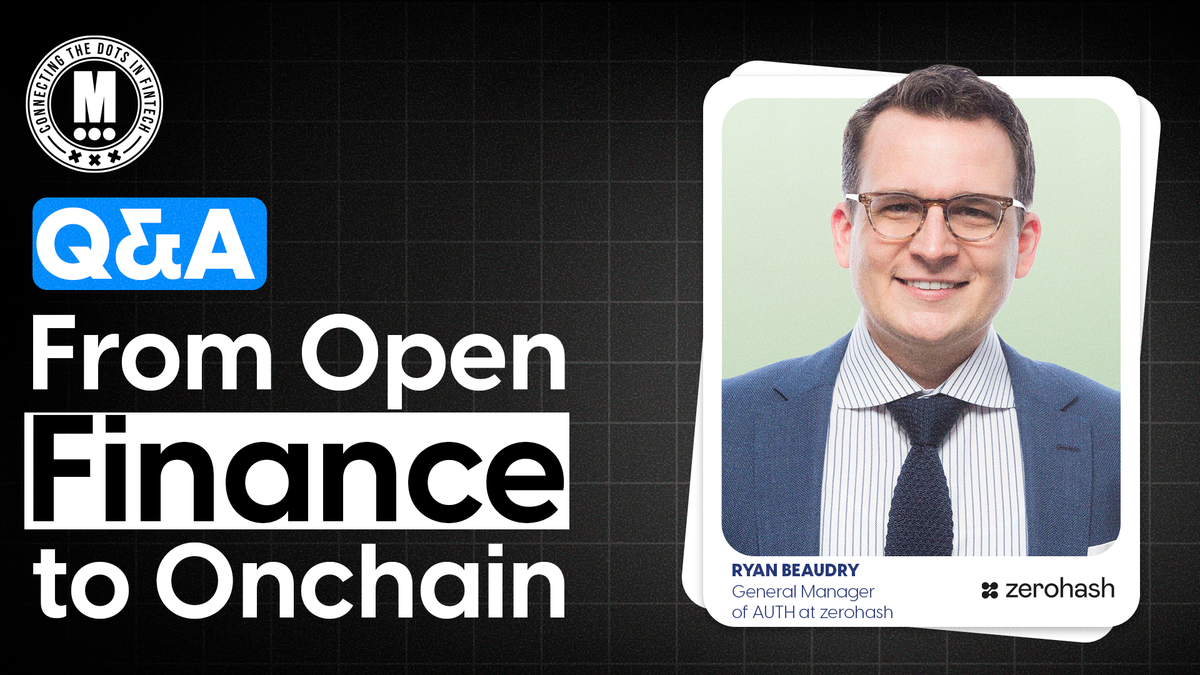
Today, I’m excited to share my latest Q&A with Ryan Beaudry, General Manager of AUTH at zerohash.
Before diving in, I recommend:
Let’s get to it!
Q1: You spent years leading open finance product and operations at Mastercard before joining zerohash. What made you want to move to onchain infrastructure?
When I started in open finance, we focused on solving how to put consumers and small businesses in control of their financial data through safe, simple account linking experiences. This unlocked so many opportunities to address real challenges that created efficiency and built personalized experiences. These ranged from streamlining account opening, personalized financial management, payment optionality, and smarter lending decisioning.
Onchain assets are at that same inflection point. The assets are real, the demand is real, and more institutions are paying attention. But the experience of moving them still feels like it belongs to an earlier era, with long addresses, network choices, and a lot of room for error. I saw a chance to apply what I’d learned about trust and usability to a space that’s ready for it. zerohash was the right place to do that because it already has the trusted, regulated infrastructure underneath. The connective layer is what’s missing, and that’s what we’re building.
Q2: Stablecoins have moved from a crypto topic to a payments topic. What changed, and what do traditional financial institutions still get wrong about them?
The use cases got concrete. Businesses have a real problem with slow, expensive settlement, especially across borders, and stablecoins are a practical answer to it. Clearer regulation then gave institutions the confidence to move from pilots to production, which was a big shift. What I still see is institutions treating stablecoins as a separate initiative that sits off to the side of the core business. The ones getting traction treat them as another payment rail, owned by the same teams and held to the same standards as everything else they run.
Q3: AUTH launched at Money20/20 USA in October. For someone outside crypto, what problem does it solve?
First and foremost, AUTH solves for any onchain movement, which may include crypto, stablecoins, tokenized securities, and more. Moving onchain assets today means copying a long wallet address, picking the right network, and hoping you got it right. One wrong character or wrong network can mean lost funds, and that’s a big barrier for mainstream users and to the true realization of the use cases onchain assets unlock for the financial ecosystem. AUTH puts users in control by letting them link accounts, and it handles the chain, so users never scan a QR code or copy an address. Each customer links their own external account, authenticates, and approves every transfer. The goal is for moving onchain assets to feel as familiar as moving money between bank accounts. Most people shouldn’t need to understand blockchain networks to send value, and with AUTH they don’t have to.
Q4: How do you think about trust and control for the institutions building on AUTH?
Platforms choose which accounts, onchain assets, and transfer types are allowed. That gives an institution the ability to match the experience to its own risk appetite and regulatory requirements, instead of accepting a one-size-fits-all approach. With classic transfers, checks happen after the assets land, and we think the controls belong before the transfer, built into the experience. Combined with the fact that every transfer is user-approved, that creates clarity for the customer and confidence for the institution. That’s what lets a regulated firm offer onchain movement as a real product and not just an experiment.
Q5: Regulation comes up in every conversation in this space. How has it shaped how you build?
We treat regulation as a design input and core to everything we do, not an obstacle. When you build with the rules in mind from day one, the product ends up better, because trust and control are part of the experience and not something added later. It also matters that zerohash has a regulated foundation. Our partners can launch onchain products without having to rebuild licensing and compliance from scratch, which saves them a lot of time and risk. As the rules continue to evolve, our job is to adapt the infrastructure so our partners can keep building on top of it without disruption.
Q6: Tokenization gets a lot of attention. Where is it real today, and where is it still early?
It’s real wherever there’s a clear operational benefit, such as faster settlement, easier access, and programmability. Those are practical advantages, and institutions are acting on them. It’s earlier where the market structure around tokenized assets, like secondary liquidity and standards, is still developing. A token alone doesn’t create a market, and you need the surrounding infrastructure for people to actually trade, move, and use it. That’s part of why ease of movement matters so much. I expect steady progress use case by use case, not one big moment.
Q7: What’s a misconception banks and FinTechs have about embedding digital assets?
That it’s mostly about the front-end experience. The user-facing piece is important, but the real work is behind it: licensing, liquidity, settlement, and risk controls. A polished app on top of weak infrastructure won’t hold up once real volume arrives. The institutions that do this well decide early what they’ll build and what they’ll rely on a partner for, and they put the hard operational questions on the table first. Partners that get that early move much faster.
Q8: What does a strong partnership between zerohash and a financial institution look like?
It starts with alignment on the customer experience. The best partners know what they want their users to be able to do, and we work backward from there. Clear ownership of compliance and operations keeps surprises at bay. The strongest partnerships also stay open and collaborative after launch. Partners tell us what their customers are asking for, and we bring what we’re seeing across the market. That feedback loop is how a good integration turns into a product that keeps improving.
Q9: What’s next for AUTH?
More connections and more places to use them. Longer term, I want linking an account to become the default way people move onchain assets, the same way it became the default in open finance. If we do our job, most users will never think about addresses or networks again.
Comments ()