Alipay is building the payment layer for everyday AI agents
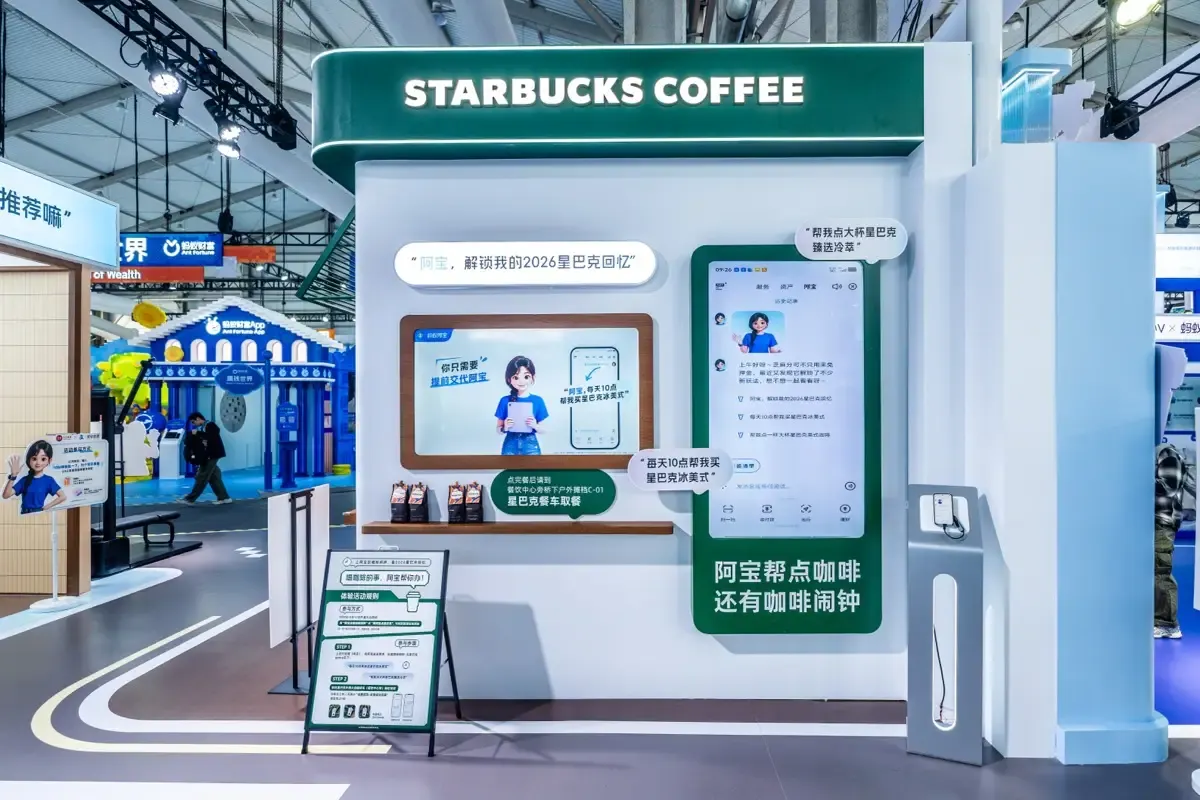
A Starbucks "coffee alarm clock" is the friendly demo. Underneath it, one of the world's biggest payment platforms is setting the terms for how AI agents spend your money.
Alipay and Starbucks have launched a service in China that lets people schedule recurring Starbucks orders through Alipay's AI agent, Ah Bao. It was unveiled on September 10 at the 2026 Inclusion Conference on the Bund in Shanghai. Ordering coffee on a timer is the pitch. For anyone in payments, the question worth asking is how the money moves.
How it works
You open Ah Bao, describe what you want, name the alarm, and turn on notifications. Tell it "order an iced Americano at 8am every day," and the agent runs it on schedule.
The key detail: the agent does not pay on its own. When a task fires, it prepares the order and asks you to review it and authorise the payment yourself. You can cancel a recurring task whenever you want. So the agent handles everything up to the checkout, and the user still approves each charge.
The payments angle
Strip away the coffee and this is a wallet move. Ah Bao sits on top of Alipay, which already holds the payment credential, the balance, and the merchant relationships for a massive base of consumers. The agent is a new front end on an existing payment account.
In agentic commerce, whoever owns the payment step owns the most valuable part of the transaction. Alipay is not asking to be invited into the checkout. It already is the checkout. The agent just decides when to trigger it.
The recurring angle is deliberate too. Most agent demos are one-off purchases; Alipay is going after recurring spend and keeps a confirmation on every charge. Recurring authorised-by-default flows are where fraud and chargebacks pile up, so per-charge consent is a risk decision, not only a UX one.
How big Ah Bao already is
Ah Bao launched in June 2026 and has scaled quickly.
By the numbers:
• Launched June 2026
• 10,000+ everyday services live
• More than a dozen categories (dining, travel, pet care, and more)
• Integrated with 5 leading smartphone brands, together 70%+ of the market
• Integrated with 16 automakers
• RMB 10 million per year committed to a new developer award
Source: Alipay, reported by PaySpace Magazine (September 2026).
Brands like McDonald's, KFC, Luckin Coffee and Haidilao are already connected for ordering and payment, each another flow settling through Alipay. And it works outside the app: Ah Bao runs on Alipay's AHA protocol, so a request can start from a Xiaomi phone's Xiao AI, your car, or AI glasses, and still route back through Alipay to settle. The wallet follows the user across devices instead of waiting for them to open one app.
The bigger picture
This lines up with the biggest question in payments right now: when an AI agent buys something, who authorises and moves the money.
In the West, that fight is at the rails. Stripe and OpenAI introduced the Agentic Commerce Protocol, Visa launched agent-payment products, and Mastercard has its own agent-pay work. In China, Alipay is coming at it from the wallet. It already has the users, the balances, and the merchants, so it can skip the standards debate and put an agent on top of an account people already use.
The coffee alarm clock is a small example of a much larger bet: that the company sitting on the payment account, not the one writing the protocol, ends up owning agent-initiated payments. The open question is whether that wallet-first model travels outside China.
Source: https://payspacemagazine.com/news/starbucks-alipay-launch-ai-coffee-alarm-clock-for-recurring-orders/

Comments ()